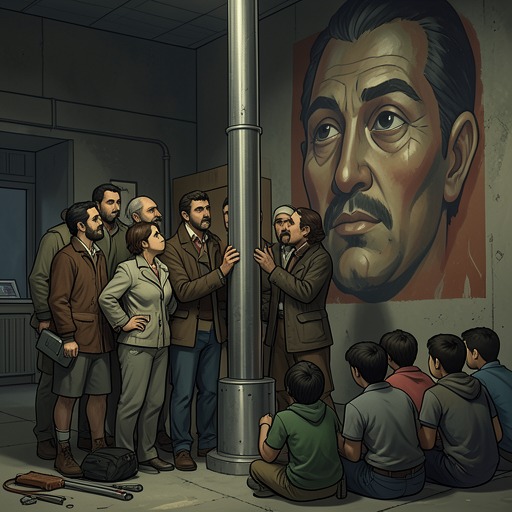
Long and Tate assault Brianna
On the Come UpLong and Tate’s assault on Brianna turns an ordinary passage through Midtown’s metal detector into a defining confrontation over safety, authority, and whose account of violence will be believed. Although the detector does not beep, Long blocks Brianna and orders her back; the ensuing restraint and search become the subject of a video she does not want released. The incident’s consequences extend beyond the encounter itself: it fuels student demands for accountability, while Brianna fears that public coverage will make her seem responsible for the treatment she received.
The encounter at Midtown
Brianna has walked through the metal detector after Curtis, Shana, Deon, three sophomores, Zane, Sonny, and Malik, and the device has not beeped. Long nevertheless puts his arm in front of her and tells her to go back. When she asks why, Tate answers that Long has given the order. The contrast with the students who have just passed through without incident makes the demand appear selective rather than a response to an alarm.
The disagreement escalates when Brianna pulls away and tells the guards to get their hands off her. Long grabs her arm again and pulls it behind her; when she struggles to free herself, he tightens his grip. Long forces her down, pins her, and Tate removes her backpack. Sonny shouts at the guards to stop, while Malik points his camera at the encounter and calls for them to get off her. The video thus records not only the physical restraint but also the immediate objections of classmates who witness it.
Why the incident becomes a public dispute
For Brianna, the assault is not an isolated episode of rough treatment. Her mother explains that Brianna and Trey were never meant to attend Garden Heights High: Jay and Brianna’s father had sworn they would not go there because the school was treated like a prison, with actual police acting as guards and little support for students’ success. Jay presents Midtown as the better chance, but Brianna challenges the promise of opportunity after being thrown down there. Jay answers that Brianna will face many more people like Long and Tate and urges her not to let their actions determine what she does.
The prospect of increased police presence at Midtown makes that fear concrete. After the guards return, Shana expects the school may follow the Garden Heights model and use actual cops as security. Malik believes parents’ acceptance of the false drug-dealer narrative about Brianna gives the school grounds, in their eyes, to treat students as threats; he predicts armed police at the doors. Brianna connects that possibility to the police killing of a boy: ever since his death, she says, seeing a police officer makes her heart race, because she could have been in his place and luck was the only difference. The assault therefore intensifies an existing fear of the school’s security regime rather than ending when the guards let go.
The video, consent, and competing accounts
Shana argues that the video Malik made of Long and Tate throwing Brianna down must reach the news if anything is to change. Brianna refuses. When she tells Shana that she does not owe anyone an explanation for withholding permission, Shana counters that the matter affects the group too. Brianna’s refusal is not indifference to what happened; she distrusts how the footage will be interpreted once it leaves the people who witnessed the incident.
She fears that a news story will explain the assault away by listing her visits to the school office, suspensions, and rap videos, making the guards’ actions appear justified because she comes from a poor neighborhood. The danger, as she sees it, is not only that the public will misunderstand the event, but that repeated public defenses of the assault may make her start doubting her own knowledge that she did not deserve it. Her insistence on controlling the video is thus part of a struggle to preserve her account against a story already circulating about her.
That competing account is visible in the coverage of the student uprising. A television report identifies Brianna’s song, “On the Come Up,” as violent and popular among young listeners, then plays selected, censored fragments. The report later says students were arrested, the guards were hospitalized but expected to recover, and students were sent home while officials considered what to do next. Jay turns off the television and asks Brianna whether the song was hers. The broadcast supplies a public frame in which the song and the unrest receive attention, while the circumstances that led students to protest—and Brianna’s account of the assault—risk being pushed aside.
Protest and institutional response
At the school-district hearing, Shana describes the uprising as the result of frustration and says students had filed complaints against Long and Tate. She points to video showing them physically assaulting a Black student and asks why they were allowed back on the job. Dr. Cook says racism and racial profiling are unacceptable but invokes the ongoing investigation as a reason he cannot discuss the specific incident. His response acknowledges the general issue without answering Shana’s direct question about the guards’ return.
Jay makes the harm personal and specific. She says she left messages for weeks without receiving a call back, then tells Dr. Cook that the assaulted student is her daughter and that Brianna was selling candy, not drugs. Turning to Karen, Jay contrasts parental fear about the effects of songs with fear for children’s safety at the hands of people meant to protect them. The room applauds. Jay then asks Dr. Cook to look at Brianna: she is sixteen, a child rather than a grown woman or a threat. She also asks him to review Brianna’s records, arguing that the school has called her aggressive for behavior as minor as rolling her eyes and questioning whether her office referrals and suspensions warranted those consequences.
The hearing places the assault within the choices Jay sees for her daughter. Garden Heights High, she says, does not set students up to succeed; Midtown is beginning to feel as though it is setting Brianna up to fail. Jay asks both as a mother and as superintendent what can be done. Dr. Cook is quiet, then apologizes for the school’s failures. The response signals an acknowledgment of harm, but it does not erase the conflict over security, discipline, or the earlier decision to return the guards to work.
Meaning and aftermath
The assault becomes a turning point because it exposes the difference between a school’s language of security and a student’s experience of being treated as a threat. The detector does not sound, yet Brianna is stopped; her classmates’ objections and Malik’s recording preserve a counter-account to the guards’ authority. The dispute then widens: students seek public attention, Brianna fears that attention will be used against her, and Jay brings the specific facts of the encounter before school leadership.
The event also makes visible how race, age, gender, and class converge in the interpretation of Brianna. At the hearing, Jay insists that the person before the administrators is a sixteen-year-old child, not the dangerous adult or drug dealer implied by public rumor. Elsewhere, radio host Hype treats a sixteen-year-old girl’s lyrics about weapons as alarming in a way he says her father’s lyrics at the same age did not provoke. The assault’s public meaning therefore cannot be separated from the assumptions that cast Brianna as aggressive or threatening, whether she is being searched at school, discussed in the news, or judged as a young woman rapper. What began with an order to go back becomes an ongoing contest over who gets to define what happened—and whether the institution will hear the child behind the label.